




- osoul center
- osoul center
- 2018
- 272
- Sixth Edition
- 14128
- 6932
- English
- 6154
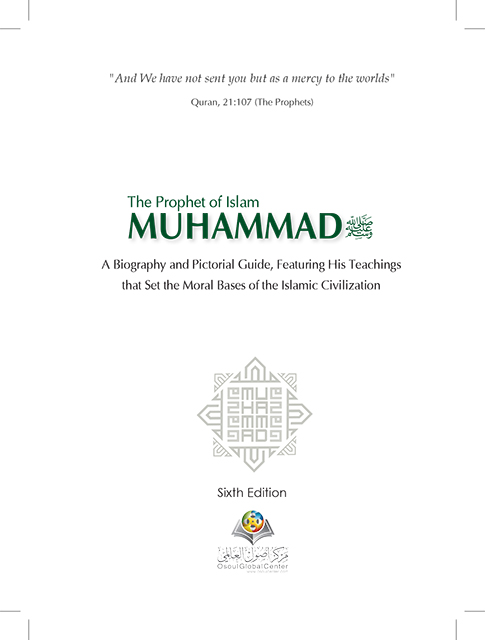
The Prophet of Islam Muhammad
A Biography and Pictorial Guide, Featuring His Teachings that Set the Moral Bases of the Islamic Civilization
All praise be to Allah the Lord of the universe and all beings. He created man in the best stature and made him able to hear, see and think.He mad him a successor in the earth and entrusted him to build the earth and not to cause any mischief in it. Accordingly, man should worship God and establish His religion (Law) on the earth. Our Creator Commandments are clear.
They command people to do good deeds and refrain from all types of bad deeds and abominations. Our Creator made our lives on earth short and temporary. Life on earth is a bridge to the eternal life in the Hereafter. That is the Day of Judgment.
Whoever does good will see it and will be rewarded for it.
And whoever does bad will see it and will be punished for it. Across the history, God sent many messengers to people to guide them to their Creator and explain to them the truth behind their creation and purpose of life.
Nuh (Noah), Ibrahim (Abraham), Musa (Moses), Isa (Jesus) and Muhammad were prophets and Messengers of God, peace be upon all of them.
However, Prophet Muhammad peace be upon him was distinguished by some important characteristics. God chose him to convey the last divine Message to humanity. It is preserved in the Quran, the last divine book to humanity. Also, Prophet Muhammad’s life was a practical demonstration and application of God’s Commandments. His teachings proved that the sincere and honest abiding with our Creator Commandments, brings benevolence, wellbeing and peace to the whole humanity. Prophet Muhammad set the moral basis of a civilization that became a turning point in the development of humanity.
Source: osoul center

 Afar
Afar Afrikaans
 Akan
Akan Albanian
 Amharic
 Armenian
 Assamese
 Avari
Avari Azerbaijani
 Basaa
Basaa Bengali
 Bosnian
 Brahui
 Bulgarian
 Burmese
 Catalan
 Chami
Chami Chechen
 Chichewa
 Circassian
 Comorian
 Czech
Czech Danish
 Dutch
Dutch Estonian
 Finnish
 Fulani
 Georgian
 Greek
Greek Gujarati
 Hausa
Hausa Hebrew
 Hungarian
 Icelandic
 Indonesian
 Ingush
 Japanese
 Jawla
Jawla Kannada
 Kashmiri
 Katlaniyah
 Kazakh
 Khmer
Khmer Kinyarwanda
 Korean
 Kurdish
 Kyrgyz
 Latvian
 Luganda
 Macedonian
 Malagasy
 Malay
Malay Maldivian
 Maranao
 Mongolian
 N'ko
N'ko Nepali
 Norwegian
 Oromo
Oromo Pashto
 Persian
 Polish
 Portuguese
 Romani - gypsy
 Romanian
 Russian
 Serbian
 Sindhi
 Sinhalese
 Slovak
 Slovenian
 Somali
 Swahili
 Swedish
 Tagalog
 Tajik
Tajik Tamazight
 Tashamiya
 Tatar
Tatar Thai
Thai Tigrinya
 Turkish
 Turkmen
 Ukrainian
 Urdu
Urdu Uyghur
 Uzbek
Uzbek Vietnamese
 Yoruba
 Zulu
Zulu