





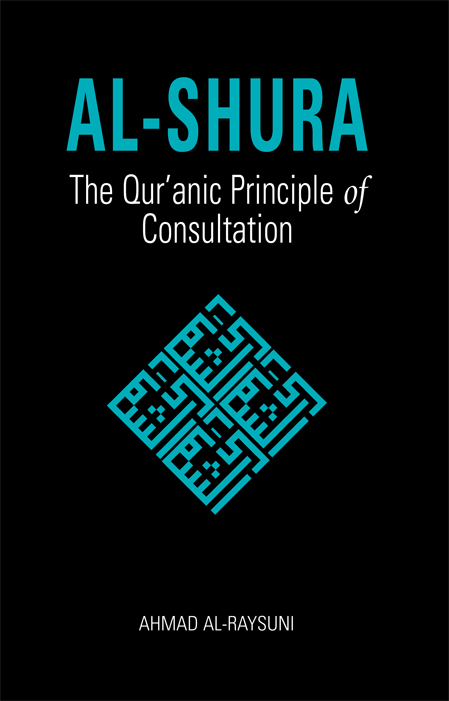
- Ahmad Al-Raysuni
- International Institute of Islamic Thought (IIIT)
- 2012
- 29
- 14702
- 5933
- English
- 6023
Al-Shura: The Qur’anic Principle of Consultation
Muslims remain largely unaware of the importance and value of the Qur’anic principle of al-Shura (mutual consultation) and the significant role it can play in the advancement and reform of Muslim society.
In this work, the author attempts to introduce and examine key meanings and practices of al-Shura, trace its historical evolution, and explore ways in which the principle can be introduced, institutionalized and applied in Muslim societies.
There is no doubt that al-Shura has been sidelined throughout the Muslim world and the reasons for this are both historically and politically complex. According to the author, although much has been written on the subject, in reality it has been at best ineffectively applied and at worst heedlessly ignored. Even today it is a hotly contested issue. As al-Shura is increasingly associated with democratic participation in a decision-making process, debate has ignited with critics challenging the notion of equating the principle with western notions of democracy, with others claiming that the principle allows for a meaning that breaks the grip of centralized power. These and other issues are investigated with careful scholarship. Al-Raysuni concludes that al-Shura should be adopted as a way of life for all Muslims to protect their interests and as a vital tool for reconstruction and reform. In doing so he addresses the subject from some intriguing new angles, giving insight into areas hitherto little, if at all, examined.

 Afar
Afar Afrikaans
 Akan
Akan Albanian
 Amharic
 Armenian
 Assamese
 Avari
Avari Azerbaijani
 Basaa
Basaa Bengali
 Bosnian
 Brahui
 Bulgarian
 Burmese
 Catalan
 Chami
Chami Chechen
 Chichewa
 Circassian
 Comorian
 Czech
Czech Danish
 Dutch
Dutch Estonian
 Finnish
 Fulani
 Georgian
 Greek
Greek Gujarati
 Hausa
Hausa Hebrew
 Hungarian
 Icelandic
 Indonesian
 Ingush
 Japanese
 Jawla
Jawla Kannada
 Kashmiri
 Katlaniyah
 Kazakh
 Khmer
Khmer Kinyarwanda
 Korean
 Kurdish
 Kyrgyz
 Latvian
 Luganda
 Macedonian
 Malagasy
 Malay
Malay Maldivian
 Maranao
 Mongolian
 N'ko
N'ko Nepali
 Norwegian
 Oromo
Oromo Pashto
 Persian
 Polish
 Portuguese
 Romani - gypsy
 Romanian
 Russian
 Serbian
 Sindhi
 Sinhalese
 Slovak
 Slovenian
 Somali
 Swahili
 Swedish
 Tagalog
 Tajik
Tajik Tamazight
 Tashamiya
 Tatar
Tatar Thai
Thai Tigrinya
 Turkish
 Turkmen
 Ukrainian
 Urdu
Urdu Uyghur
 Uzbek
Uzbek Vietnamese
 Yoruba
 Zulu
Zulu