





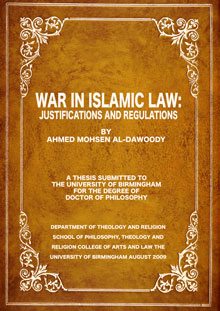
- Ahmed Al-Dawoody
- The University of Birmingham
- August 2009
- 443
- 18587
- 8971
- English
- 6350
War in Islamic Law
This study examines the justifications and regulations for going to war in both international and domestic armed conflicts under Islamic law. It studies the various kinds of use of force by both state and non-state actors in order to determine the nature of the Islamic law of war, specifically, whether Islamic law sanctions “holy war”, offensive war or only defensive war. It discusses international armed conflicts, i.e., war against non-Muslims, in the first four chapters: Chapters One, Two and Three treat the justifications for war in the Sīrah (biographies of the Prophet) literature, Tafsīr (exegesis) literature, and classical and modern juridical literature respectively. Chapter Four treats the Islamic regulations for war in international armed conflicts. Chapter Five is devoted to the justifications and regulations for the use of force in internal armed conflicts. It investigates the permissibility under Islamic law of resorting to the use of force to overthrow the governing regime and discusses the Islamic treatment of terrorism and the punishment of terrorists and their accomplices. It also discusses the claim that contemporary acts of domestic and international terrorism perpetrated by Muslims are motivated and justified by jihād. This study is limited to the four Sunni schools of Islamic law and also refers in some cases to the extinct Zāhirī school. It studies the writings of classical and modern Muslim jurists and scholars and compares them with the Western literature on the subject.
This study finds that jihād, in the sense of international armed struggle, as the term is currently used, is a defensive war justified in cases of aggression on the Muslim nation and fitnah, i.e., the persecution of Muslims. It also finds that the core justification in Islamic law for the use of force in domestic armed conflicts, and which may give an indication to future conflicts in the Muslim world, is the violations of the rules of the sharī‛ah. The study concludes that the Islamic law of
war as maintained by the majority of mainstream Muslims scholars has great potential for contributing to international peace and security in the modern world, particularly with regard to the humanization of armed conflicts and the peaceful resolution of internal conflicts.



 Afar
Afar Afrikaans
 Akan
Akan Albanian
 Amharic
 Armenian
 Assamese
 Avari
Avari Azerbaijani
 Basaa
Basaa Bengali
 Bosnian
 Brahui
 Bulgarian
 Burmese
 Catalan
 Chami
Chami Chechen
 Chichewa
 Circassian
 Comorian
 Czech
Czech Danish
 Dutch
Dutch Estonian
 Finnish
 Fulani
 Georgian
 Greek
Greek Gujarati
 Hausa
Hausa Hebrew
 Hungarian
 Icelandic
 Indonesian
 Ingush
 Japanese
 Jawla
Jawla Kannada
 Kashmiri
 Katlaniyah
 Kazakh
 Khmer
Khmer Kinyarwanda
 Korean
 Kurdish
 Kyrgyz
 Latvian
 Luganda
 Macedonian
 Malagasy
 Malay
Malay Maldivian
 Maranao
 Mongolian
 N'ko
N'ko Nepali
 Norwegian
 Oromo
Oromo Pashto
 Persian
 Polish
 Portuguese
 Romani - gypsy
 Romanian
 Russian
 Serbian
 Sindhi
 Sinhalese
 Slovak
 Slovenian
 Somali
 Swahili
 Swedish
 Tagalog
 Tajik
Tajik Tamazight
 Tashamiya
 Tatar
Tatar Thai
Thai Tigrinya
 Turkish
 Turkmen
 Ukrainian
 Urdu
Urdu Uyghur
 Uzbek
Uzbek Vietnamese
 Yoruba
 Zulu
Zulu