





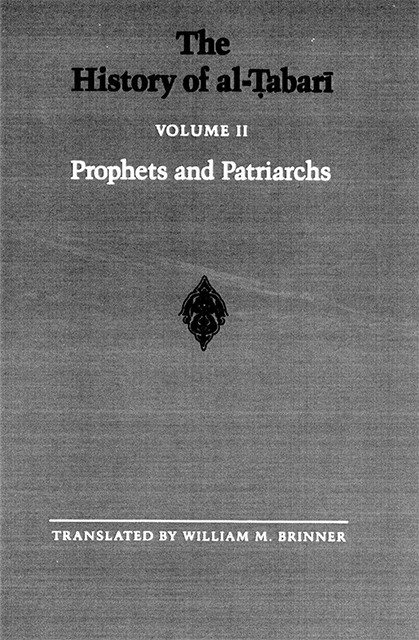
- Muhammad ibn Jarir al-Tabari
- State University of New York Press
- Franz Rosenthal
- 1989
- 220
- 28522
- 10092
- English
- 8699
The History of Al-Tabari Volume 2
The History of al-Tabari :Tarikh al-Rusul wa’l muluk ‘Annals of the Apostles and Kings’ ,by Abu Ja’far Muhammad b Jarir al-Tabri (839-923). It is by common consent the most important universal history produced in the world of Islam.
Prophets and Patriarchs
This volume records the lives and efforts of some of the prophets preceeding the birth of Mohammad. It devotes most of its message to two towering figures–Abraham, the Friend of God, and his great-grandson, Joseph.
The story is not, however simply a repetition of Biblical tales in a slightly altered form, for Tabari sees the ancient pre-Islamic Near East as an area in which the histories of three different peoples are acted out, occasionally meeting and intertwining.
Thus ancient Iran, Israel, and Arabia serve as the stages on which actors such as Biwarasb, the semi-legendary Iranian king, Noah and his progeny, and the otherwise unknown Arabian prophets Hud and Salih appear and act.
Before proceeding to the story of Joseph, which is recounted in great detail, we linger over the accounts of two figures associated with ancient Arabia in Muslim tradition: the Biblical Job, who despite his trials and sufferings does not rail against God, and Shu’ayb, usually associated with the Biblical Jethro, the priest of Midian and father-in-law of Moses.
Finally we meet Joseph, whose handsome appearance, paternal preference, and subsequent boasting to his brothers lead to his being cast into a pit and ending up as a slave in Egypt.
His career is traced in some detail: the attempted seduction by Potiphar’s wife, his imprisonment and eventual release after becoming able to interpret dreams, and his rise to power as ruler of Egypt.
Source: kalamullah








 Afar
Afar Afrikaans
 Akan
Akan Albanian
 Amharic
 Armenian
 Assamese
 Avari
Avari Azerbaijani
 Basaa
Basaa Bengali
 Bosnian
 Brahui
 Bulgarian
 Burmese
 Catalan
 Chami
Chami Chechen
 Chichewa
 Circassian
 Comorian
 Czech
Czech Danish
 Dutch
Dutch Estonian
 Finnish
 Fulani
 Georgian
 Greek
Greek Gujarati
 Hausa
Hausa Hebrew
 Hungarian
 Icelandic
 Indonesian
 Ingush
 Japanese
 Jawla
Jawla Kannada
 Kashmiri
 Katlaniyah
 Kazakh
 Khmer
Khmer Kinyarwanda
 Korean
 Kurdish
 Kyrgyz
 Latvian
 Luganda
 Macedonian
 Malagasy
 Malay
Malay Maldivian
 Maranao
 Mongolian
 N'ko
N'ko Nepali
 Norwegian
 Oromo
Oromo Pashto
 Persian
 Polish
 Portuguese
 Romani - gypsy
 Romanian
 Russian
 Serbian
 Sindhi
 Sinhalese
 Slovak
 Slovenian
 Somali
 Swahili
 Swedish
 Tagalog
 Tajik
Tajik Tamazight
 Tashamiya
 Tatar
Tatar Thai
Thai Tigrinya
 Turkish
 Turkmen
 Ukrainian
 Urdu
Urdu Uyghur
 Uzbek
Uzbek Vietnamese
 Yoruba
 Zulu
Zulu