





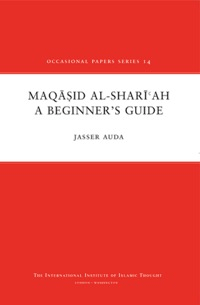
- Jasser Auda
- The International Institute of Islamic Thought
- 2008
- 71
- 22461
- 9823
- Contemporary Issues
- 8140
Maqasid al-Shariah : A Beginner’s Guide
Children often come up with deep philosophical questions, and one cannot tell whether they mean these questions or not! However, the beauty of a child’s question is that it is often not bound by pre-set ‘facts’ or ‘this is the way things are’ logic. I often start courses on a with the story of a little girl who asked her father: ‘Dad, why do you stop the car at the traffic light?’ Her father replied, with an educative tone: ‘Because the light is red, and red means stop.’ The girl asked: ‘But why?’ The Dad replied also with a tone of education: ‘So the policeman does not give us a ticket.’ The girl went on: ‘But why would the policeman give us a ticket?’ The Dad answered: ‘Well. Because crossing a red light is dangerous.’ The girl continued: ‘Why?’ Now the Dad thought of saying: ‘This is the way things are,’ but then decided to be a bit philosophical with his little beloved daughter. Thus, he answered: ‘Because we cannot hurt people. Would you like to be hurt yourself?’ The girl said: ‘No!’ The dad said: ‘And people also do not want to be hurt. The Prophet (peace be upon him) said: “Love for people what you love for yourself.”’ But instead of stopping there, the girl asked: ‘Why do you love for people what you love for yourself?’ After a bit of thinking, the father said: ‘Because all people are equal, and if you would like to ask why, I would say that God is The Just, and out of His Justice, He made us all equal, with equal rights, and that is the way He made the world!’
Current applications (or rather, misapplications) of Islamic law are reductionist rather than holistic, literal rather than moral, one-dimensional rather than multidimensional, binary rather than multi-valued, deconstructionist rather than reconstructionist, and causal rather than teleological.
Source: noor-book

 Afar
Afar Afrikaans
 Akan
Akan Albanian
 Amharic
 Armenian
 Assamese
 Avari
Avari Azerbaijani
 Basaa
Basaa Bengali
 Bosnian
 Brahui
 Bulgarian
 Burmese
 Catalan
 Chami
Chami Chechen
 Chichewa
 Circassian
 Comorian
 Czech
Czech Danish
 Dutch
Dutch Estonian
 Finnish
 Fulani
 Georgian
 Greek
Greek Gujarati
 Hausa
Hausa Hebrew
 Hungarian
 Icelandic
 Indonesian
 Ingush
 Japanese
 Jawla
Jawla Kannada
 Kashmiri
 Katlaniyah
 Kazakh
 Khmer
Khmer Kinyarwanda
 Korean
 Kurdish
 Kyrgyz
 Latvian
 Luganda
 Macedonian
 Malagasy
 Malay
Malay Maldivian
 Maranao
 Mongolian
 N'ko
N'ko Nepali
 Norwegian
 Oromo
Oromo Pashto
 Persian
 Polish
 Portuguese
 Romani - gypsy
 Romanian
 Russian
 Serbian
 Sindhi
 Sinhalese
 Slovak
 Slovenian
 Somali
 Swahili
 Swedish
 Tagalog
 Tajik
Tajik Tamazight
 Tashamiya
 Tatar
Tatar Thai
Thai Tigrinya
 Turkish
 Turkmen
 Ukrainian
 Urdu
Urdu Uyghur
 Uzbek
Uzbek Vietnamese
 Yoruba
 Zulu
Zulu