





- E-Da`wah Committee (EDC)
- E-Da`wah Committee
- 2016
- 10
- 17342
- 8251
- Christianity
- 7318
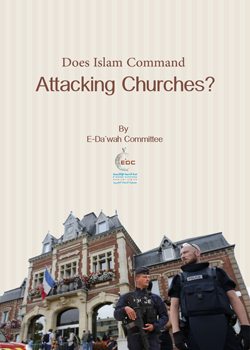
It is safe to say that a given religion can be judged correctly only by two things: its own teachings and the practice of the mainstream doctrine of this religion. A religion cannot be judged by the centrifugal practices or beliefs of some followers, be they liberal or extremist, hither or thither.
Attacking the places of worship is a criminal act which is done by individual followers of all religions all over the world. It is unfair to claim that it is Muslims only who attack the places of worship.
In fact, Islam prohibits any assault against the places of worship. The alleged attacks on the places of worship if really carried out by Muslims go against the well-established Islamic teachings. Such acts serve as odd precedents in the Islamic history. Suffice it to say they break with tradition.
The Messenger of Allah once wrote to the bishop of Banu Al-Harith Ibn Ka’b and the bishops and priests of Najran, their followers and their monks that everything, small or great, pertaining to their churches, chapels and monasteries would remain in their possession, that Allah and His Messenger would guarantee that no bishop would be removed from his see, nor any monk from his monastery, nor any priest from his office and none of their rights or powers would be changed as long as they were sincere and good, and no cruelty would be shown to them. This was scribed by Al-Mughirah.
Umar ibn Al-Khattab, the Second Muslim Caliph, concluded a treaty with the people of Jerusalem which read:
This is the assurance of safety which the servant of God, Umar, the Commander of the Faithful, has granted to the people of Jerusalem. He has given them an assurance of safety for themselves, for their property, their churches, their crosses, the sick and the healthy of the city, and for all the rituals that belong to their religion. Their churches will not be inhabited [by Muslims] and will not be destroyed. Neither they, nor the land on which they stand, nor their crosses, nor their property will be damaged. They will not be forcibly converted. The people of Jerusalem must pay the poll tax like the people of [other] cities, and they must expel the Byzantines and the robbers. All this from the book they shall have as a pact of Allah, and as protection from his Messenger, from the Caliphs as well as from the Believers if they pay the jizyah. Witnesses of this are: Khalid bin Walid, `Amr bin al-`As, `Abd Al-Rahman bin `Awf and Mu`awiya bin Abi Sufyan. It was written with all present in the 15th year after Hegira.
Khalid bin Al-Walid, the renowned Muslim commander, concluded a similar treaty with the people of Damascus which read:
This is what Khalid bin Al-Walid shall grant to the people of Damascus: He shall grant them protection [and safety] for their lives, property [and possessions], their churches, and the walls of their cities. Nothing of their quarters will be destroyed nor shall anyone live in them. This they shall have as a pact of Allah, protection from his Messenger, from the Caliphs as well as from the Believers and nothing but good will remain for them if they pay the jizyah.


 Afar
Afar Afrikaans
 Akan
Akan Albanian
 Amharic
 Armenian
 Assamese
 Avari
Avari Azerbaijani
 Basaa
Basaa Bengali
 Bosnian
 Brahui
 Bulgarian
 Burmese
 Catalan
 Chami
Chami Chechen
 Chichewa
 Circassian
 Comorian
 Czech
Czech Danish
 Dutch
Dutch Estonian
 Finnish
 Fulani
 Georgian
 Greek
Greek Gujarati
 Hausa
Hausa Hebrew
 Hungarian
 Icelandic
 Indonesian
 Ingush
 Japanese
 Jawla
Jawla Kannada
 Kashmiri
 Katlaniyah
 Kazakh
 Khmer
Khmer Kinyarwanda
 Korean
 Kurdish
 Kyrgyz
 Latvian
 Luganda
 Macedonian
 Malagasy
 Malay
Malay Maldivian
 Maranao
 Mongolian
 N'ko
N'ko Nepali
 Norwegian
 Oromo
Oromo Pashto
 Persian
 Polish
 Portuguese
 Romani - gypsy
 Romanian
 Russian
 Serbian
 Sindhi
 Sinhalese
 Slovak
 Slovenian
 Somali
 Swahili
 Swedish
 Tagalog
 Tajik
Tajik Tamazight
 Tashamiya
 Tatar
Tatar Thai
Thai Tigrinya
 Turkish
 Turkmen
 Ukrainian
 Urdu
Urdu Uyghur
 Uzbek
Uzbek Vietnamese
 Yoruba
 Zulu
Zulu