




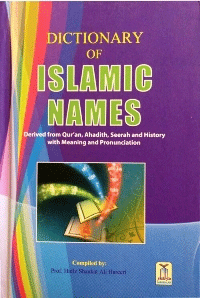
- Hafiz Shaukat Ali Hareeri and Hafiz Muhammad Ikram Tahir
- 2009
- 239
- 105947
- 19658
- English
- 15859
Islamic Names Dictionary
Dictionary of Islamic Names and the definition of each one.
The first lesson given to Adam (PBUH) after his creation was the knowledge of names, which established his superiority over the angels, and became the reason for their prostration to him.
Although the Holy Qur’an does not give the names that Adam (PBUH) was taught, it does say that the earliest form of knowledge imparted to man by his Creator was the knowledge of names. The first lesson also established the identity of objects and human beings from the beginning.
Through the Holy Qur’an the Creator got Himself identified by His Name (Allah) and reinforced this identity through His various Attributive Names, asserting that one can call Him by anyone of His beautiful names, as the Holy Qur’an says:
“The Most Beautiful Names belong to Allah.”
Besides the identity of the individual, names also reflect the religion, moral values, nation and the country of persons.Therefore, neonate babies should be given good names.
Children are a great blessing of Allah, termed as blossoms of Paradise by the Messenger of Allah (PBUH).
The best way of expressing joy on the birth of a child is to express gratitude to Allah for this favor. Feeling hurt and disappointed at the birth of a daughter is against the teachings of Islam, and unbecoming for a Muslim.
In the Holy Qur’an Allah asserts that:
“To Allah belongs the kingdom of the heavens and the earth. He creates what He wills. He bestows female (offspring) upon whom He wills, and bestows male (offspring) upon whom He wills, Or He bestows both males and females, and He renders barren whom He wills.”

 Afar
Afar Afrikaans
 Akan
Akan Albanian
 Amharic
 Armenian
 Assamese
 Avari
Avari Azerbaijani
 Basaa
Basaa Bengali
 Bosnian
 Brahui
 Bulgarian
 Burmese
 Catalan
 Chami
Chami Chechen
 Chichewa
 Circassian
 Comorian
 Czech
Czech Danish
 Dutch
Dutch Estonian
 Finnish
 Fulani
 Georgian
 Greek
Greek Gujarati
 Hausa
Hausa Hebrew
 Hungarian
 Icelandic
 Indonesian
 Ingush
 Japanese
 Jawla
Jawla Kannada
 Kashmiri
 Katlaniyah
 Kazakh
 Khmer
Khmer Kinyarwanda
 Korean
 Kurdish
 Kyrgyz
 Latvian
 Luganda
 Macedonian
 Malagasy
 Malay
Malay Maldivian
 Maranao
 Mongolian
 N'ko
N'ko Nepali
 Norwegian
 Oromo
Oromo Pashto
 Persian
 Polish
 Portuguese
 Romani - gypsy
 Romanian
 Russian
 Serbian
 Sindhi
 Sinhalese
 Slovak
 Slovenian
 Somali
 Swahili
 Swedish
 Tagalog
 Tajik
Tajik Tamazight
 Tashamiya
 Tatar
Tatar Thai
Thai Tigrinya
 Turkish
 Turkmen
 Ukrainian
 Urdu
Urdu Uyghur
 Uzbek
Uzbek Vietnamese
 Yoruba
 Zulu
Zulu